
Drawing Excellence and Sequentially Progressive Modules
Figure Drawing
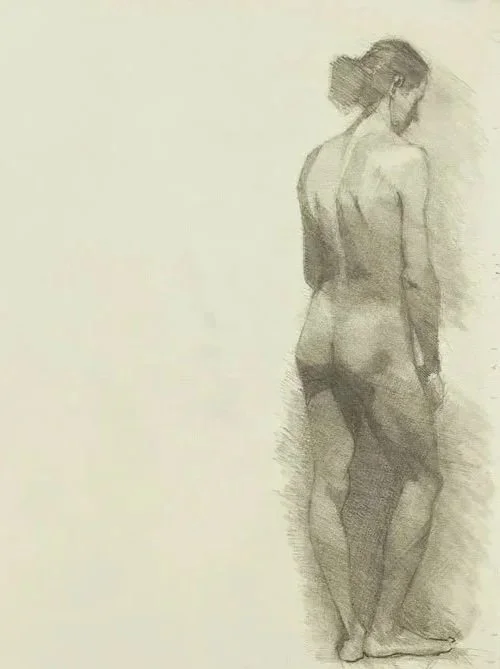
Figure drawing is approached through a classical academic method in which the student learns to observe and construct the human figure with accuracy, clarity, and discipline. Working directly from the model, students bring together the observational principles developed in the previous stages of the program and apply them to the complexity of the living figure.
The drawing begins with a strong block-in, establishing the overall placement, scale, gesture, proportion, and major structural relationships of the figure. Particular attention is given to the accuracy of line and form, with the student learning to assess the figure as a unified structure rather than as a collection of isolated parts. The initial drawing is kept clear and economical, allowing corrections to be made while the major relationships are still being established.
The foundational charcoal drawing is progressively developed through a careful study of the figure’s structure and proportion. Students learn to identify the principal masses, axes, and directional relationships that organize the pose, while observing how the underlying structure informs the appearance of the body. Gesture is considered not simply as an expressive quality, but as an essential element in understanding the movement and overall organization of the figure.
Once the construction has been established, the drawing progresses toward the study of light and shadow. Through chiaroscuro, students learn to organize the tonal structure of the figure and to use value to describe the turning of form, the planes of the body, and the relationship between light and shadow. The modeling is developed gradually, maintaining the structural clarity of the initial block-in while introducing increasingly subtle transitions and variations of tone.
The extended duration of the pose is an essential part of this process. The average pose is maintained for approximately two to four weeks, giving students sufficient time to move beyond the initial construction and undertake a sustained study of proportion, structure, anatomy, and tonal modeling. The extended pose also allows students to work through successive stages of observation and correction, developing the patience, concentration, and discipline required for a fully resolved figure drawing.
The figure therefore represents a significant progression from the study of casts and controlled subjects toward direct observation of the living model. It provides students with the opportunity to integrate accuracy of drawing, structural understanding, gesture, and chiaroscuro into a single sustained study, establishing the foundations necessary for more advanced work in figure painting and portraiture.


