
Drawing Excellence and Sequentially Progressive Modules
Portrait Painting
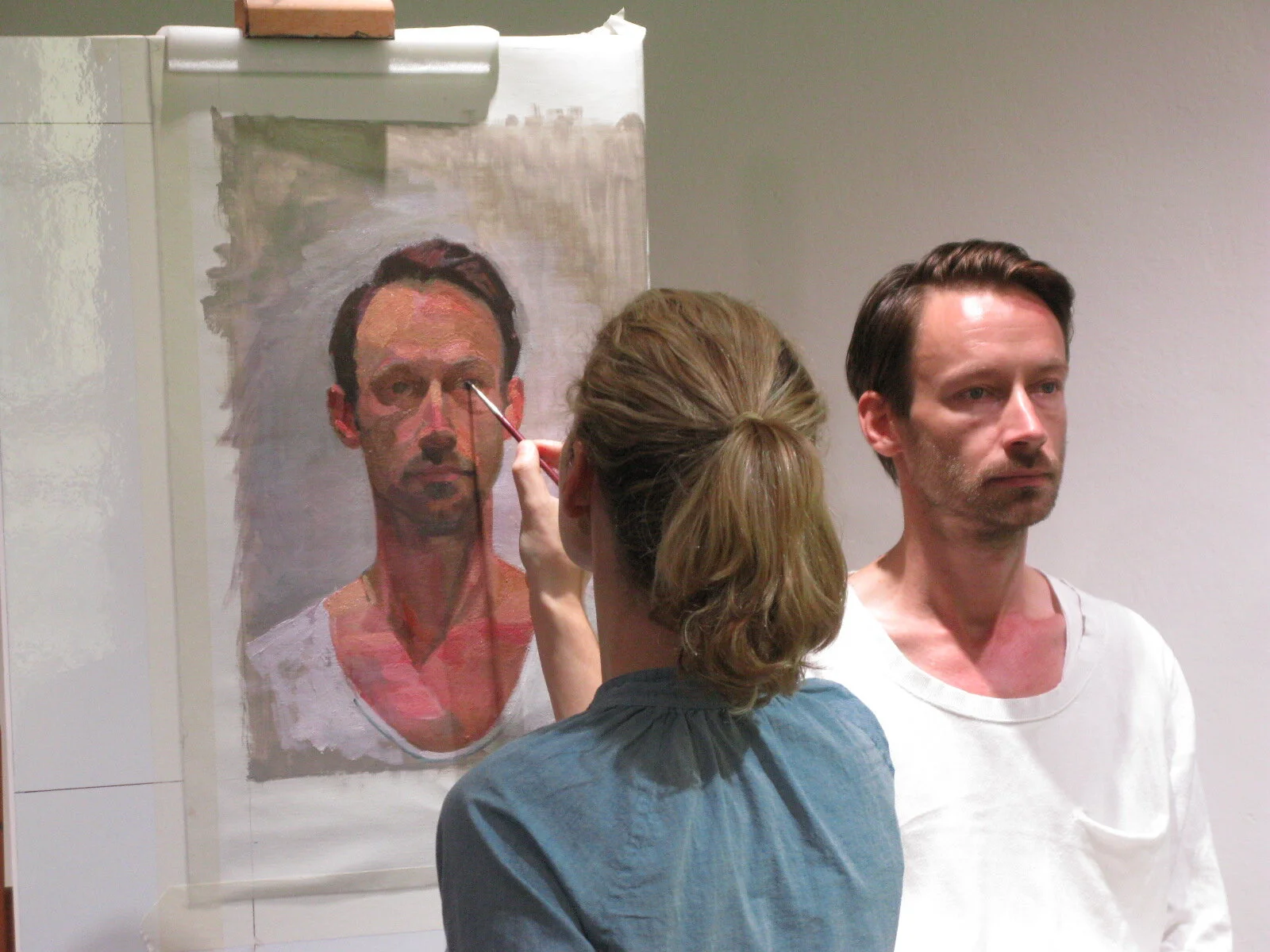
Building on the successful completion of the previous studies, students are introduced to the complete process of developing a painting of the human figure from life. The emphasis is placed on gaining confidence with the medium of oil paint and on understanding the practical and technical procedures required to begin, develop, and bring a painting to completion.
The process begins with a strong block-in drawing of the model, establishing the overall placement, proportion, gesture, and principal structural relationships of the figure. Once the drawing has been carefully developed and checked, it is transferred to a prepared panel or canvas, providing a sound foundation for the painting that follows.
Before beginning the final work, students prepare bozzetti or color studies to investigate the composition, value structure, and principal color relationships. These preparatory studies allow different possibilities to be considered before the larger painting is undertaken and help students develop a more deliberate approach to the organization of the final work.
The painting itself is developed through a structured sequence of stages. A carefully considered underpainting is first established to define the principal masses, values, and relationships of light and shadow. Students initially work with a limited color palette, learning to control the relationships between colors and to establish the overall unity of the painting. As their understanding and handling of the medium develop, they progress toward a fuller palette, introducing a broader range of hues, temperatures, and degrees of saturation.
Particular attention is given to the practical handling of oil paint. Students learn how to mix and control color, organize their palette, apply and manipulate paint, and build the painting progressively without losing the clarity of the underlying structure. The relationship between drawing, value, and color remains central throughout the process, with each stage building upon the decisions established in the previous one.
The aim is to make students increasingly comfortable and confident in handling paint while giving them a clear understanding of the procedures involved in completing a painting. Rather than approaching painting as a collection of isolated techniques, students learn to understand it as a continuous process in which preparation, construction, observation, correction, and refinement are interconnected.
The extended pose provides the time necessary to experience the full development of a painting from life. The average pose is maintained for approximately two to four weeks, allowing students to work through the successive stages at a measured pace and to receive guidance as the painting develops. This extended period also gives students the opportunity to identify and resolve problems rather than rushing toward a finished result.
By completing the entire process—from the initial drawing and preparatory studies through the underpainting and successive layers of color—students gain a practical framework that can be applied to future paintings. The goal is to develop both technical confidence and an understanding of how to approach a painting systematically, from its first decisions to its final resolution.


